Posts

The Cutthroat Worlds of Business Development and Game of Thrones - Part 3
Image
As I asserted the last two articles ( Article 1 , Article 2 ), roughly two months after the season finale aired of Game of Thrones, I still can’t help but see similarities between the cutthroat environment of the show and the world of business development. The show is about a web of alliances and conflicts among the various parties involved—all of whom are seeking to gain control and power. Within the world of business development, it is much the same. Various companies are competing against one another for work—each wanting to gain more and more control and power over their sector(s). Within these organizations, individuals are similarly fighting for power and control—some with the company’s interest at heart, and others looking out only for themselves. And within this world, we develop a web of partners and competitors—both at the individual and corporate levels. In the last two articles, I looked at eight popular  Game of Thrones characters, drawing parallels to ...

How Business Development is like Game of Thrones – Part 2

Image
As I asserted in last week’s article, roughly two months after the season finale aired of Game of Thrones, I still can’t help but see similarities between the cutthroat environment of the show and the world of business development. The show is about a web of alliances and conflicts among the various parties involved—all of whom are seeking to gain control and power. Within the world of business development, it is much the same. Various companies are competing against one another for work—each wanting to gain more and more control and power over their sector(s). Within these organizations, individuals are similarly fighting for power and control—some with the company’s interest at heart, and others looking out only for themselves. And within this world, we develop a web of partners and competitors—both at the individual and corporate levels. In last week’s article , I looked at four of my favorite Game of Thrones characters, drawing parallels to the types of individuals we ...

How Your Favorite Game of Thrones Characters Align with Common Business Development Personalities, and Strategies for Collaborating with Each – Part 1

Image
Nearly two months after the season finale aired of Game of Thrones, I still can’t help but see similarities between the cutthroat environment of the show and the world of business development (BD). The show is about a web of alliances and conflicts among the various parties involved—all of whom are seeking to gain control and power. Within the world of business development, it is much the same. Various companies are competing against one another for work—each wanting to gain more and more control and power over their sector(s). Within these organizations, individuals are similarly fighting for power and control—some with the company’s interest at heart, and others looking out only for themselves. And within this world, we develop a web of partners and competitors—both at the individual and corporate levels. In this week’s blog, I’ll take a look at four of my favorite Game of Thrones characters, drawing parallels to the types of individuals we might come across in our li...

Revising and Editing: A Fun Little Mnemonic Device to Remember the Difference

Image
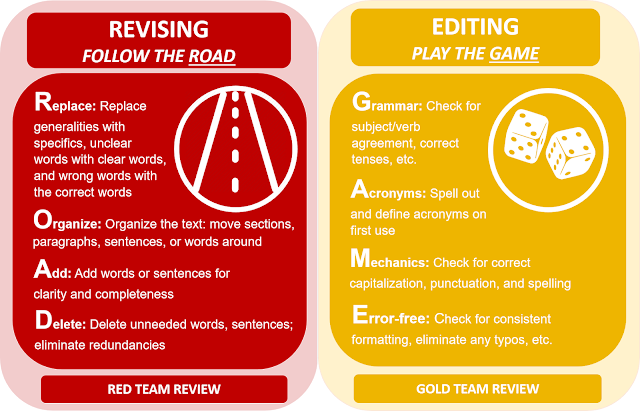
I recently posted an article that aligned the proposal development process to the standard 5-Step Writing Process  (if you missed it, you can check it out here ). This week I’m expanding on the last two steps of this process: revising and editing. We often use the terms revising and editing interchangeably, but they are actually unique processes, each with differing goals: Revising, which happens between the Pink and Red Team Reviews, aims at making content updates and structural changes that will clarify your narrative and message. Editing, which happens between Red and Gold Team Reviews, aims at making grammatical and mechanical changes so that your narrative is clean and correct. Mirroring similar memory devices, to help you remember the difference between the two, I have come up with this fun little mnemonic device: follow the ROAD and play the GAME . REVISING, MAKING IT BETTER: FOLLOW THE ROAD After the Pink Team review, you’ll want to read what you h...

Bid & Proposal Professional’s Survival Kit

Image
Bid and proposals can be a tough profession, and sometimes we need a little extra motivation and support to help us through the chaos. I love this Bid & Proposal Professional’s Survival Kit —I generated it using inspiration from similar survival kits out there for other professions. This is a great little kit you can put together to brighten a coworker’s day, to use for holiday give exchanges in the office, or to welcome a new coworker to the team. I have personally used a version of this survival kit in several office holiday gift exchanges. And if you’re needing just a little extra motivation yourself, I’ve included a few extra words of encouragement with each item below for this week’s blog. Marker: To remind you to leave a good mark—with your team and with the customer. As bid and proposal professionals, we have the ability to influence our teams, our coworkers, and our customer. It is critical for us to use this influence thoughtfully and conscientiously. We must ...

Proposals and the Art of Persuasion: How we can Apply Aristotle’s Three Rhetorical Appeals

Image
What is a proposal other than a persuasive document? If you’ve studied the art of rhetoric or persuasion, you’ll know that many of the principles we apply today originated with some of the great Greek philosophers, particularly Aristotle. Dating from the 4th century BCE, Aristotle’s Rhetoric discusses three means of persuasion: ethos, logos, and pathos. If you have read my article on the “ Seven Cs of Proposal Writing ,” you might recognize that these directly align to three of my Seven C’s: Ethos: those grounded in credibility (Credible) Logos: those grounded in the patterns of reasoning (Compelling) Pathos: those grounded in the emotions or psychology of the audience (Customer Focus) Ethos (Credible) The direct translation of ethos is “ethics.” Ethos refers to what makes the bidding organization credible. In your proposals, you should aim to establish ethos by using rhetorical devices that will make you appear credible: Use the appropriate language for your c...

Aligning Proposal Development with the Standard 5-Step Writing Process

Image
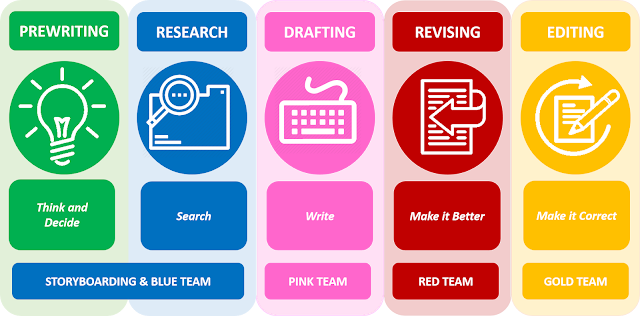
Proposal writing can be stressful. We often yank authors away from their day jobs, or worse, ask them to perform both tasks at the same time. What’s more, we throw all of these foreign terms at them: Pink Team, Red Team, and Gold Team. It can be overwhelming for even the seasoned proposal professional! Sometimes it can be helpful to step back and break thing down into terms that may be more familiar to your authors. For example, most authors will have seen the standard 5-step writing process before. In this week’s article, I’ve aligned the proposal development process to the standard 5-Step Writing Process ; the one I used for this post is published by the University of Kansas (KU) Writing Center. STEP 1: PREWRITING Think & Decide Make sure you understand your assignment. Before you dive into writing the section, you should review the limitations of your assigned task. Consider things such as your page limits and relevant RFP sections to address. You should al...